
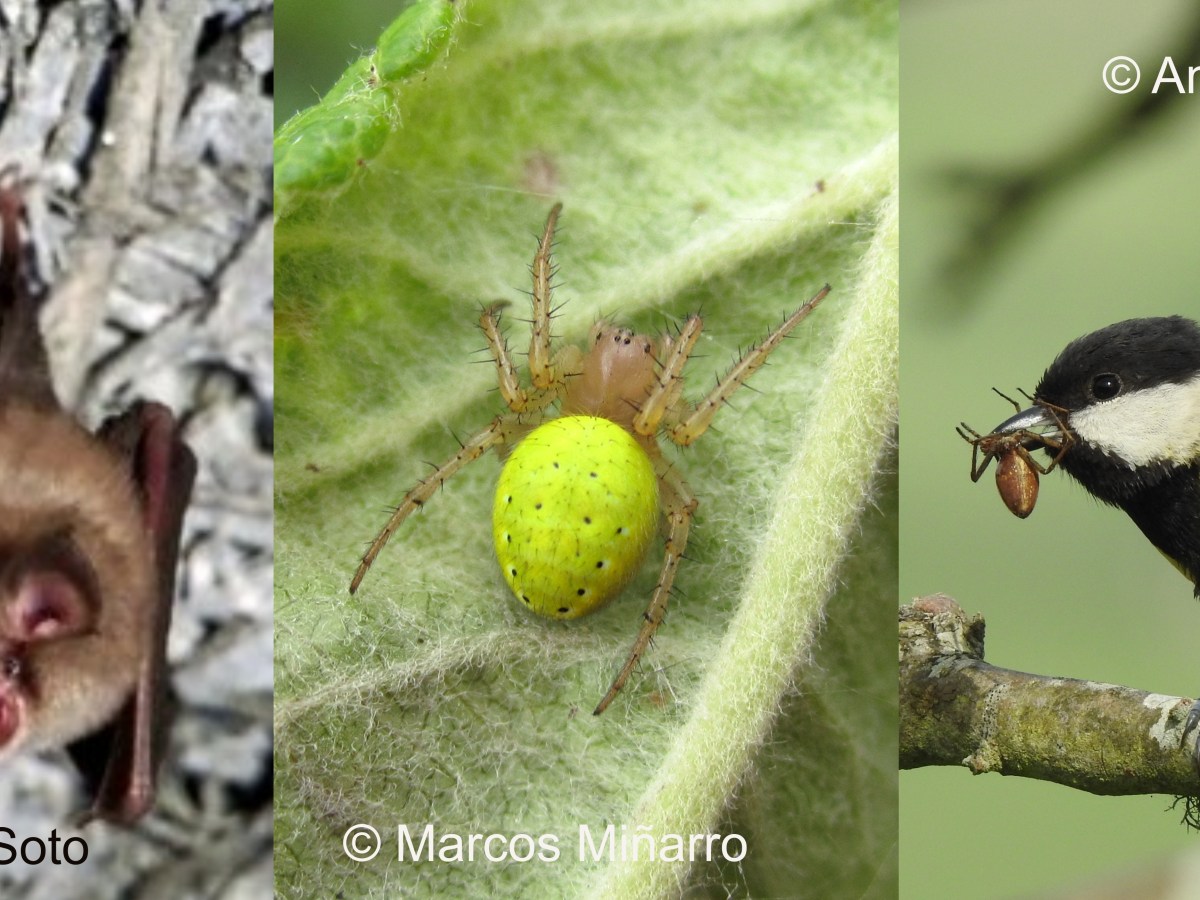
New Publication: Batman or Robin? … perhaps Spidey! The complex interactions between birds, bats and spiders as natural enemies of pests in fruit orchards
Flying vertebrates such as birds and bats are well known as providers of pest control in agriculture. However, being insectivores, they may prey not only on pest insects, but also on other arthropods, like spiders, acting as natural enemies too. In this article, we tackle this issue by combining DNA-metabarcoding from dietary samples of birds, bats and spiders and…

New Publication: Bats as pest managers in cropland: the species and the season matter
European bats are insectivorous animals able to control arthropod pests in agricultural crops. However, their role in heterogeneous landscapes remains poorly known. In this article, we analyse bats’ diet through arthropod DNA-metabarcoding from their faecal samples in a bocage landscape of Asturias, N Spain. We compared the occurrence of different pest species in different bat species and seasons across…

New Publication: Do ants defend honey-dew producing hemipterans from their parasitoids?
The relationship between phloem-feeding insects, like aphids, and “shepherd” ants is a paradigmatical example of mutualism in almost every Ecology textbook. However, the knowledge about how ants defend honey-dew producing hemipterans from their major enemies – parasitoids – is scarce and dispersed. Ángel Plata and their colleagues from IVIA-Valencia develop an outstanding and comprehensive review to tackle this issue.…

New Publication: Bees matter for apple pollination all over the world, especially wild ones
The relevance of pollinators for food production is widely accepted, but we still lack of information on many global crops. Within a big team led by Maxime Eeraerts, we review the current evidence of pollination in apple, a major fruit crop across the world. We found a consistent pattern of pollen limitation in crops of different territories and latitudes,…

New Publication: Who eats blueberry crops? Mostly wild boars and blackbirds, and sometimes affecting yield
Blueberry crops are an attractive and easy-to-eat resource for wild vertebrates, which may ultimately decrease crop yields by intense frugivory. In this new study, a part of Javi Jiménez-Albarral’s PhD, we analyse the patterns of blueberry consumption by wild vertebrates in orchards in northern Spain, estimating experimentally the actual effects on crop yield. By using direct observation and camera…
Something went wrong. Please refresh the page and/or try again.

